Three kinds of allowance
Provisional sum: an amount included for work that cannot yet be fully described or priced, such as "underpinning if required, £3,000" or "drainage diversion, £2,500". When the work is instructed, the allowance is removed and replaced with the actual cost of the work as valued under the contract.
Prime cost (PC) sum: an amount for an item you have not chosen yet, usually something you will select, such as "sanitaryware PC £1,800" or "kitchen supply PC £9,000". The builder fits it; the price is adjusted to what the item really costs, often plus an agreed percentage for handling and profit.
Contingency: a reserve for the unknown. It may be in the builder's price as a separate line, or (better for you) held by you outside the contract.
Provisional sums and PC sums are both adjusted to actual cost, so they move the final price. In the quote comparison worksheet they go in the same "provisional sums" line because they carry the same risk.
Defined and undefined provisional sums
Larger JCT contracts and standard measurement rules distinguish two types:
- Defined: the nature and extent of the work is described (for example "replace drain run approx 8 m, depth up to 1.2 m"). The builder should have allowed for its effect on the programme and preliminaries.
- Undefined: the work cannot be described yet. The builder can claim extra time and preliminaries if the work turns out to be large.
Domestic quotes rarely make this distinction, but the idea is useful: the better you can describe an allowance, the less it can grow.
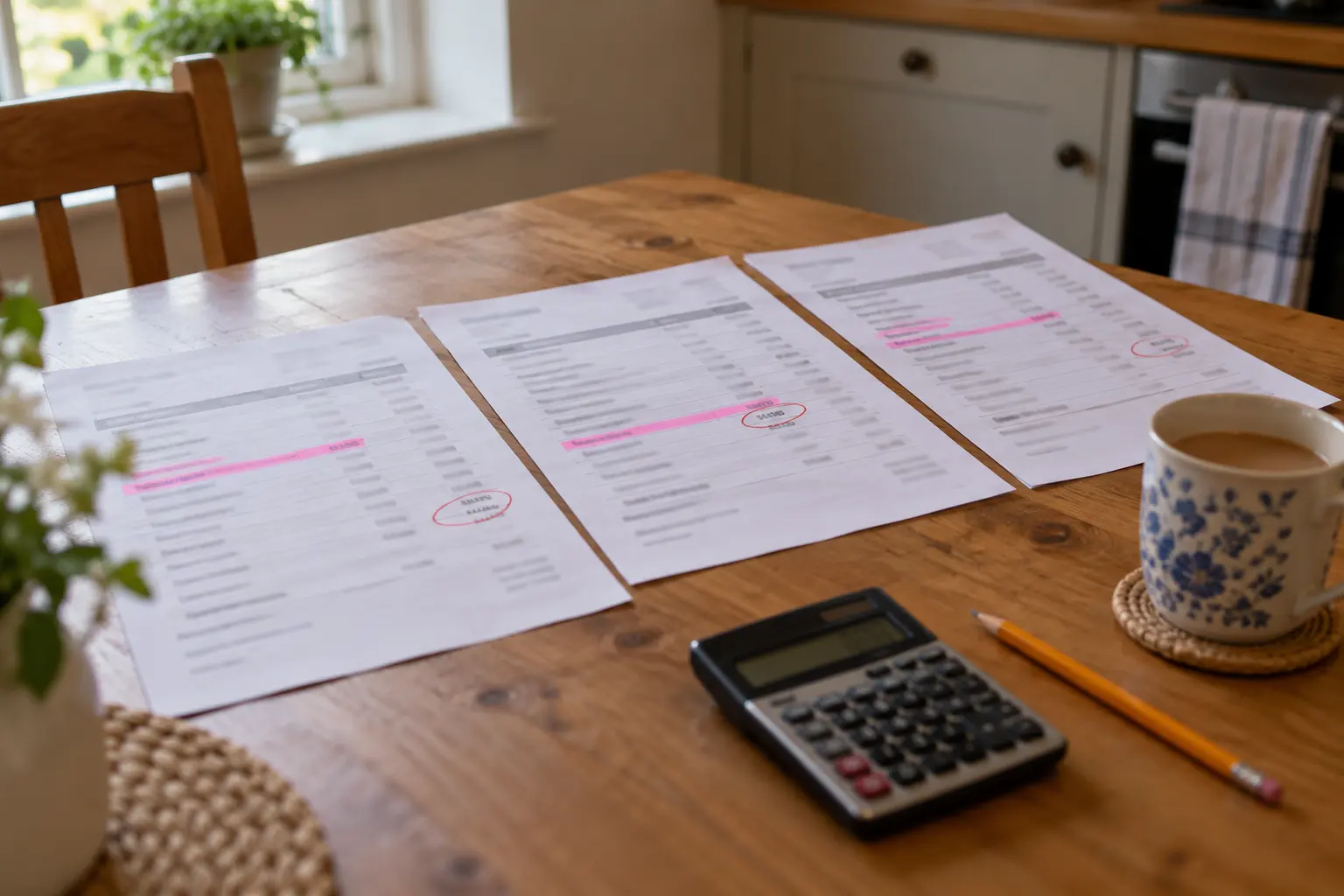
How much is too much?
There is no rule, but a practical guide for a domestic extension once the design is complete:
| Share | What it usually means | What to do |
|---|---|---|
| Under 10% | A genuinely firm price with a few sensible unknowns | Check each allowance is realistic |
| 10% to 15% | Some important items are not yet decided | Firm up the largest one or two before signing |
| Over 15% | A large part of the "fixed price" is a guess | Ask for firm prices, finish design decisions, or treat the quote as an estimate |
The worksheet flags anything over 15% as high risk, and 10% to 15% as worth watching.
The trick of low allowances
An allowance set too low makes a quote look cheaper. "Kitchen supply PC £5,000" against a kitchen you will realistically spend £12,000 on makes that quote £7,000 cheaper on paper and £7,000 dearer in reality. When comparing quotes, either make every builder use the same allowance figures (you set them in the tender), or replace each builder's allowance with your own realistic figure before comparing.
Worked example: equalising allowances
Builder X allows £6,000 for kitchen supply and £1,200 for flooring. Builder Y allows £10,000 and £2,500. Your realistic figures are £11,000 and £2,800.
- Adjust X: +£5,000 kitchen, +£1,600 flooring = +£6,600
- Adjust Y: +£1,000 kitchen, +£300 flooring = +£1,300
If X was £5,000 cheaper before adjustment, Y is now £300 cheaper. Check whether the builder's handling percentage applies to the increase too.
Your own contingency
Separate from anything in the quote, keep a contingency you control. Typical guidance for domestic work:
- 10% for a new-build style extension on a clear site with full drawings.
- 15% for typical extensions to older houses, where you will be opening up existing walls, floors and drains.
- 20% or more for period, listed or heavily altered properties, or where the design is not finished.
Include the VAT on that contingency. A 10% contingency on a £75,000 plus VAT job is £9,000, not £7,500.
Contingency is not a design budget. If you plan to upgrade the kitchen or add rooflights during the build, that is a known change. Budget for it separately and keep the contingency for genuine surprises such as unexpected foundations, rotten timbers, asbestos or a drain in the wrong place.
Managing allowances during the build
- Keep a running sheet. List each allowance, the amount, and the actual cost when known. Update it at every stage payment.
- Get a price before instructing. When a provisional sum item is needed, ask for a quote for it first.
- Ask for evidence for PC items. The supplier invoice, with any agreed handling percentage shown separately.
- Close them out. In the final account every allowance should have been replaced with an actual figure. Unused ones come off the price.
Allowances you will often see on extensions
- Foundations deeper than standard (trees, clay, poor ground)
- Drainage diversion or build-over agreement works
- Structural steel beyond the engineer's design
- Kitchen, sanitaryware, flooring, tiles, light fittings
- Making good existing finishes after opening up
- Asbestos survey and removal in pre-2000 houses
Some of these overlap with approvals. A public drain under the footprint usually needs the sewerage company's written consent before you build over it, and foundations near a neighbour can need a party wall notice. See building control and party walls.
How to reduce allowances before you sign
Most allowances exist because a decision has not been made yet. The cheapest way to cut risk is to make the decision early:
- Choose the fittings. Pick the kitchen, sanitaryware and flooring before tender, so builders can price supply and fit as firm items. Even a shortlist of two products with prices narrows the range.
- Investigate the ground. A trial pit next to the existing foundations (often a few hundred pounds) tells you the depth and soil type, so the builder can price foundations rather than allow for them.
- Survey the drains. A CCTV drain survey shows where the runs are and what condition they are in. It often removes the largest single provisional sum on an extension.
- Get the structural design finished. Ask the engineer to size every beam and padstone. "Steel to engineer's design, allowance £3,000" becomes a firm price.
- Commission an asbestos survey on any house built before 2000 if you are removing walls, ceilings or floors. Removal costs are then known rather than guessed.
Each of these costs a little up front. Together they can turn a quote with 20% allowances into one with 5%, which is worth far more than the fees in fewer arguments and a more reliable budget.
Setting allowances yourself in a tender
On the traditional route, your architect or you can write fixed allowances into the tender documents: "Include the provisional sum of £9,000 for kitchen supply" and "Include a PC sum of £45 per m² for floor tiles". Every builder then carries exactly the same figures, so the difference between quotes is only in the work they actually priced. This is the single most effective way to make quotes comparable, and it costs nothing.
Common questions
What is the difference between a provisional sum and a prime cost sum?
A provisional sum covers work that is not yet defined; a prime cost sum covers an item you have not chosen yet. Both are adjusted to actual cost, so both move the final price.
Can a builder add profit to a PC sum?
Usually yes, if agreed. A handling or profit percentage of around 5% to 15% on PC items is common. Agree the percentage in writing before signing.
Should contingency be in the contract or held by me?
Holding it yourself is generally better: it is only spent when you agree it is needed. If it sits in the contract sum, make sure it is clearly shown and only spent on your instruction.